
Unleashing Accountability Through The “Oz Principle”
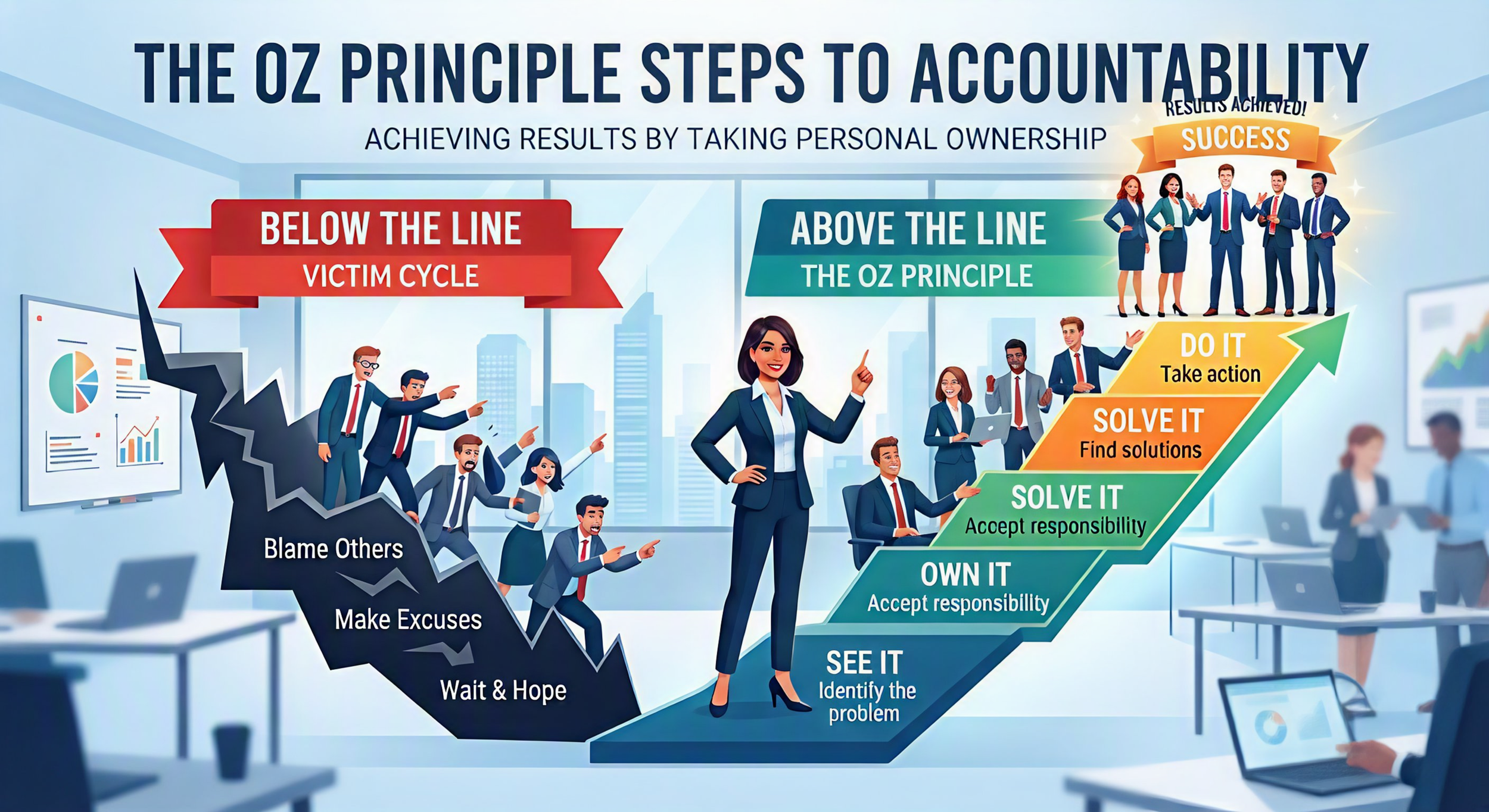
Driving Success Through Accountability: Mastering The Oz Principle
In today’s fast-paced business environment, accountability is the definitive line separating organizations that merely survive from those that dominate their industries. “The Oz Principle”—authored by Roger Connors, Tom Smith, and Craig Hickman—draws a brilliant parallel to The Wizard of Oz. Just as Dorothy and her companions sought the Wizard for attributes they already possessed within themselves, individuals and organizations often look externally for solutions, success, and leadership, failing to realize that true power lies in taking absolute ownership of their reality.
This comprehensive framework shifts teams away from a toxic culture of finger-pointing and excuses, anchoring them firmly in a results-oriented mindset.
The Core Framework: Above the Line vs. Below the Line
At the heart of The Oz Principle is the separation between two distinct operating states. To achieve breakthrough results, leaders must constantly evaluate where their teams are operating:
1. Below the Line: The Victim Cycle (Reactive & Defensive)
When challenges strike, struggling cultures instantly drop "Below the Line." Here, people act as victims of circumstance, paralyzing progress through:
- Ignore / Deny: Pretending problems don’t exist or hoping they will magically go away on their own.
- Finger-Pointing / Blaming: Shifting responsibility onto other departments, economic conditions, vendors, or management.
- Confusion / Irrelevance: Hiding behind ambiguity, saying things like “That’s not my job description” or claiming a lack of clarity to avoid action.
- Tell Me What to Do: Waiting passively for step-by-step instructions rather than exercising critical thinking or initiative.
2. Above the Line: The Accountability Pyramid (Proactive & Results-Driven)
To cross "Above the Line," individuals must actively climb a four-step framework that transforms problems into outcomes:
- See It: Objectively acknowledging reality without distortion, denial, or emotional bias. You cannot fix what you refuse to look at.
- Own It: Accepting personal responsibility for your circumstances, role, and impact on the outcome. Rejecting excuses entirely.
- Solve It: Actively brainstorming, collaborating, and figuring out what needs to be done. Asking: “What else can I do to drive a successful result?”
- Do It: Executing the solution with discipline, consistency, and resilience, seeing the task through to a successful finish.
Accountability in Action: Transforming a Service Department
The true power of The Oz Principle isn't found in a textbook, it's forged in the trenches of daily operations. Early on in my career, while working as a Service Manager for a large dealer group, I inherited an environment plagued by a classic "Below the Line" culture. Whenever jobs stalled, deadlines were missed, or customer complaints rolled in, the default response was immediate self-protection: excuses, blame, and finger-pointing.
Frustrations were mounting, technician efficiency was dropping, and customer trust was eroding. Recognizing that standard management tactics weren't working, I introduced my team to The Oz Principle. We stopped asking, “Whose fault is this?” and forced a fundamental shift by asking a single, uncomfortable, yet empowering question:
“What could I have done to make the outcome better?”
I challenged my team to audit their own behaviors when a job went sideways by breaking down the problem-solving loop:
- What could I have done to prevent this technical oversight?
- What actionable steps can I take right now to salvage this repair and satisfy the customer?
- How can I contribute to the solution instead of magnifying the obstacle?
As a leader, turning the mirror inward forced me to evaluate my own operational contributions:
- Did my technicians have the specialized training required for this complex diagnostic job?
- Did I ensure they had the precise tooling and equipment needed to execute efficiently?
- Was my communication clear, or did I leave room for ambiguity in work orders?
- Did I foster an environment where team members felt safe admitting mistakes, or did my reactions inadvertently drive them into hiding?
By shifting our collective mindset Above the Line, the cultural transformation was undeniable. Excuses were systematically replaced by accountability. Mechanics started communicating proactively with service writers, parts shortages were handled collaboratively before they stalled production, and customer satisfaction metrics soared.
Implementing The Oz Principle wasn't just about managing workflow; it was about rewriting our organizational DNA. Once absolute accountability took root, exceptional results naturally followed. Through this sustained shift in mindset and culture, our team climbed the ranks to become the #1 branch in the entire dealer group, shattering performance expectations.
Strategic Blueprint: How to Implement The Oz Principle Today
If you want to replicate this level of high-performance success within your own organization, integrate these foundational pillars:
- Foster Radical Transparency: Create a psychological safety net where team members feel comfortable exposing failures early, viewing mistakes as data points rather than punishable offenses.
- Anchor Goals to Ownership: Clearly define roles and tie individual responsibilities directly to broader organizational objectives so that no one can hide behind ambiguity.
- Equip, Don't Just Expect: Pair accountability with enablement. Ensure your team has the tools, training, and resources required to deliver excellence before holding them accountable for results.
- Celebrate Above the Line Behaviors: Publicly recognize initiative, problem-solving, and ownership. Reinforce the behaviors you want to see replicated across the floor.
Reflection Questions for Leaders
As you look at your own team or department today, consider these critical assessments:
- Where are Below the Line behaviors (blame, excuses, denial) currently draining your department's productivity?
- How often do you model "Own It" behavior, or do you find yourself slipping into justifications when targets are missed?
- What systems can you implement today to transition your team from passive problem-reporters to active problem-solvers?
By embracing The Oz Principle and driving past the illusion of the status quo, you unlock the ultimate capacity for sustainable growth, operational excellence, and team success.
References & Further Reading
(405) 928-4461