
Mobile Field Service vs. The Shop
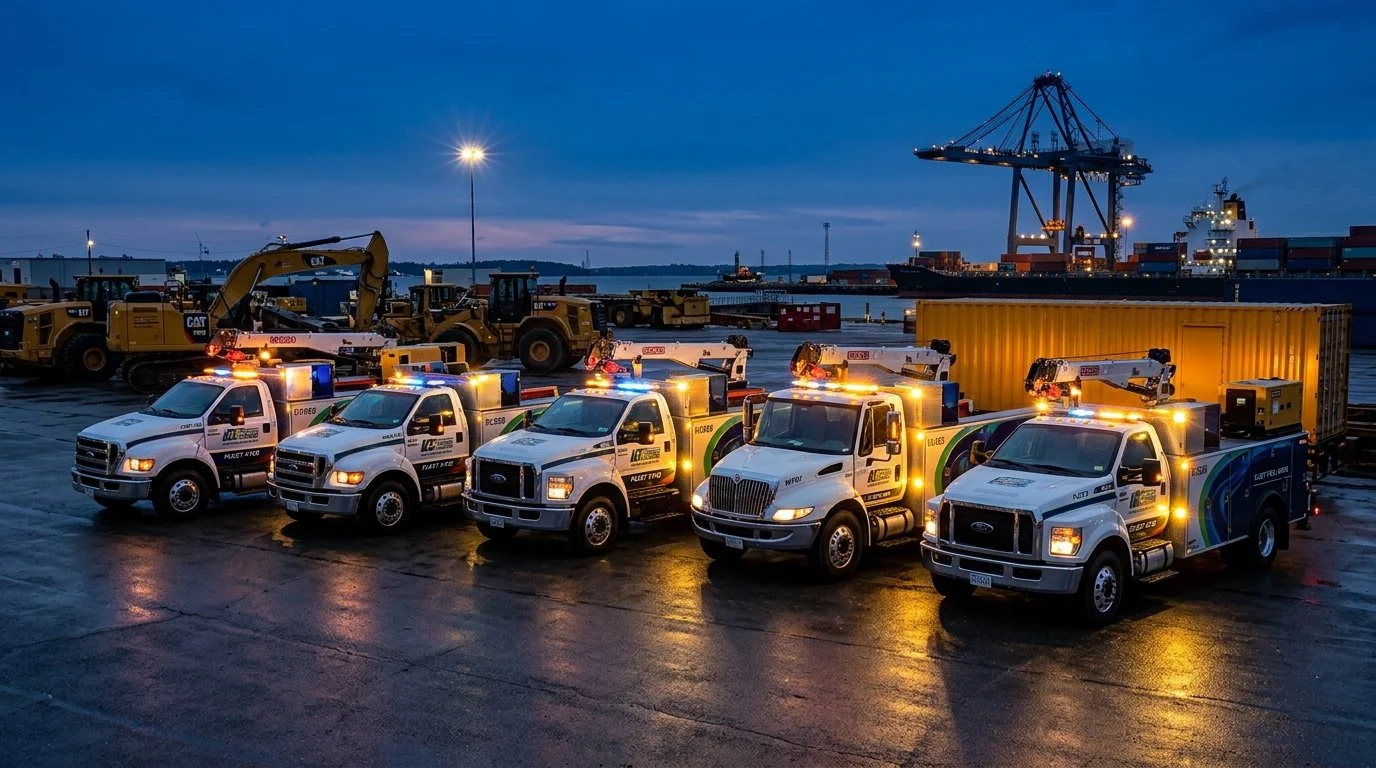
Mobile Field Service vs. the Shop: Diesel Operations & Hiring Guide
Structuring labor profitability, operational risk, and autonomous talent across on-highway, heavy civil, marine, and power generation sectors.
Operational Economics, Compensation & Fleet Efficiency
The primary financial drivers are effective labor billing rate differentials, unabsorbed bay overhead, technician utilization, dispatch density, and capital asset velocity.
Billing Multipliers & Gross Margin: In many markets, field service commands a premium over comparable shop labor rates, with some organizations billing approximately $165–$265/hr depending on market, sector, specialization, and customer requirements. Separate dispatch, mileage, zone, or mobilization charges may also be used. While in-shop work requires covering physical brick-and-mortar overhead such as facility costs, utilities, hazardous-waste management, and dedicated support staff, mobile service shifts a greater portion of the operating investment onto the rolling service asset.
Capital Asset Velocity: In-shop major overhauls, such as out-of-frame commercial rebuilds or heavy equipment engine and transmission work, can tie up a single bay for extended periods. Waiting on back-ordered components, machine-shop work, or specialized parts can further reduce bay availability. Field operations instead emphasize rapid uptime restoration through triage, selective component replacement, wiring harness repairs, ECM and CAN-bus troubleshooting, sensor calibration, and other targeted repairs.
Break-Even Considerations: A fully equipped mobile service truck can require a substantial capital investment, potentially reaching the $160,000–$280,000 range depending on chassis, crane, welding and power systems, fluid-management equipment, tooling, inventory, and configuration. Actual break-even performance depends heavily on utilization, billing rates, travel recovery, service territory, dispatch density, labor costs, truck financing, and maintenance. Under favorable operating conditions, a properly deployed mobile unit can potentially recover its equipment investment relatively quickly while producing strong labor economics compared with a comparable stationary operation.
In-shop mechanics may be compensated through traditional flat-rate, modified flat-rate, base-hourly, or hourly-plus-efficiency structures based on standard repair times (SRTs). Mobile field service generally benefits from a guaranteed hourly compensation structure because travel, site access, diagnostics, customer interaction, weather, job-site conditions, and unpredictable repair requirements make pure flat-rate compensation difficult to administer fairly.
Base Hourly + Field Premiums: Many employers use a premium above equivalent in-shop journeyman rates to recognize the additional responsibility, independent decision-making, environmental exposure, customer interaction, travel, and on-call requirements associated with autonomous field service. A premium in the range of approximately $4.00–$10.00 per hour may be appropriate in some markets, but the actual amount should be established according to local labor conditions, equipment specialization, travel expectations, and the employer's total compensation package.
Travel-Time Compensation: Employers should establish a clearly defined travel-time policy that complies with applicable federal and state wage-and-hour requirements. Ordinary home-to-work commuting is generally treated differently from travel between worksites during the workday. Some employers voluntarily provide portal-to-portal compensation as a recruiting and retention strategy, but it should not be presented as a universal federal requirement.
On-Call & Emergency Standby Compensation: A structured mobile fleet may use tiered on-call compensation:
- Standby Compensation: A flat daily or shift stipend for carrying the dispatch phone and remaining within the required response area, subject to company policy and applicable wage requirements.
- Call-Out Guarantees: A minimum paid call-out period may be used for emergency after-hours dispatches, with the exact duration and treatment determined by company policy and applicable wage-and-hour requirements.
Performance Incentives: Rather than tying bonuses purely to SRT hours, mobile technician incentives can reward first-time fix rate (FTFR), reduced return trips caused by misdiagnosis, billable recovery against total travel time, customer satisfaction, and truck maintenance and inventory accuracy.
Blending shop formulas with field formulas can distort labor-performance data. Service directors should distinguish between Efficiency and Utilization.
Labor Efficiency Formula:
Labor Efficiency = (Standard Billable Hours Produced / Actual Hands-On-Tool Hours Expended) × 100
Example: A technician completing work credited with 8 standard billable hours in 6.5 actual hands-on-tool hours has an efficiency of approximately 123%.
Labor Utilization Formula:
Labor Utilization = (Actual Billable Hours Invoiced / Total Paid Hours Included in the Company's Utilization Model) × 100
Field Benchmarks vs. Shop Benchmarks: Fixed shop operations can generally support higher utilization because technicians remain at the facility. Mobile field service normally operates at a lower utilization percentage because travel, site access, safety meetings, customer check-in, traffic, parts acquisition, and other field activities consume paid time. A utilization target of 60%–75% may be reasonable for some mobile operations, but the appropriate benchmark depends heavily on service territory, customer density, dispatch model, and how travel is billed.
Operational Recovery: Profitability can be improved through appropriate labor billing, travel-time recovery, zone pricing, dispatch fees, minimum service charges, or other pricing structures that account for the actual cost of putting a technician and service vehicle on the road.
Build High-Utilization Field Teams with American Diesel Outfitters →
Carrying too much truck stock can consume payload capacity, reduce fuel economy, and increase inventory carrying costs; carrying too little can reduce the First-Time Fix Rate and create non-billable return trips.
Dynamic Min/Max Based on Territory Data: Effective mobile fleets typically use dynamic inventory levels based on historical consumption, failure patterns, equipment population, service territory, and technician specialization. If an EPG technician's territory includes primarily data centers running Cummins QSK60 and Kohler KD-series platforms, for example, truck stock can be configured around the specific equipment population rather than using a generic inventory list.
Consumable Standard Kits: Rather than loose fittings, trucks can carry pre-assembled diagnostic and repair kits:
- Complete JIC/ORFS hydraulic cap and plug assortments.
- Deutsch and Weather-Pack connector repair cases with appropriate ratcheting crimpers.
- Common OEM high-failure sensors such as crank/cam position, exhaust back-pressure, DEF pressure, and manifold air-temperature sensors.
RFID & Barcode Mobile Scanning: Technicians can scan parts using mobile barcode or RFID systems connected to field-service-management software. Parts consumed on an invoice can trigger replenishment workflows at the primary branch or parts counter, reducing inventory gaps and keeping commonly required components staged for the technician.
While minor top-end overhauls, cylinder-head work, injector replacement, turbocharger replacement, and selected in-frame repairs can often be performed on-site, comprehensive major overhauls become less practical when the job requires controlled machining, extensive teardown, specialized lifting, or prolonged exposure to uncontrolled environmental conditions.
Machining & Tolerances: If the engine block requires counterbore machining, deck resurfacing, line boring of main bearing saddles, or crankshaft grinding, those operations generally require controlled shop equipment and environmental conditions. Field machining may also introduce contamination and quality-control challenges that are difficult to manage in uncontrolled environments.
Crane Load Limits & Structural Access: If extracting the complete engine, transmission, or counterweight package exceeds the safe working capacity of the available service crane, a secondary crane or transportation solution may become more economical than attempting to complete the work in the field. The decision should account for lifting capacity at the required working radius, mobilization costs, site access, transportation, and downtime.
Tear-Down Duration & Environmental Exposure: Long-duration teardown work increases exposure to humidity, rain, dust, contamination, security concerns, and other environmental variables. Where the repair requires extensive internal engine exposure or extended component storage, a controlled shop environment may provide better protection for the engine and greater consistency with OEM repair and warranty requirements.
Source Certified In-Shop Overhaul Master Technicians with ADO →
Cross-Sector Technical Demands, Tooling & Safety Compliance
An in-shop on-highway overhaul technician excels at mechanical execution: dropping oil pans, pulling cylinder heads, measuring liner protrusion with dial indicators, fitting main bearings, and setting overhead lash to exact OEM specifications. They work in controlled environments with access to OEM manuals, parts support, specialty fixtures, and other resources.
Advanced Multiplexing & Data-Link Diagnostics: A significant portion of modern on-highway field service involves electrical, electronic, communications-network, and emissions-related diagnostics rather than purely mechanical wear. The technician may need to use multi-channel digital storage oscilloscopes (DSOs) to capture transient voltage events and signal abnormalities across J1939/CAN networks, legacy J1708/J1587 systems, and newer CAN-FD architectures.
Modern Aftertreatment Triage: The field technician must distinguish actual mechanical failures, such as a restricted DPF or crystallized DEF dosing system, from electrical or software-related faults such as sensor-circuit problems, heater-circuit faults, communication failures, or high-resistance grounds.
Field Software Autonomy: The field technician should be capable of independently navigating diagnostic platforms such as Cummins INSITE, Detroit DiagnosticLink, Volvo/Mack Tech Tool, or PACCAR DAVIE4 to perform appropriate regenerations, cylinder cutout tests, ECU programming, calibration procedures, and parameter configuration without immediate shop-foreman assistance.
Equipping a heavy civil, quarry, or mining field service vehicle requires balancing payload constraints with self-contained lifting, welding, compressed air, electrical power, fluid handling, and diagnostic capability.
Chassis & Crane Requirements: Depending on the application, a Class 5 through Class 7 chassis such as a Ford F-550/F-750, Ram 5500, or medium-duty vocational chassis may be configured with a hydraulic service crane in an appropriate capacity range. Crane selection must account for the required lifting capacity at the actual working radius, not simply the crane's maximum rated capacity.
All-In-One Power Systems: Dedicated hydraulic or diesel-driven auxiliary power systems can combine an air compressor, multi-process welder, generator, and battery jump-start capability for 12V/24V commercial systems. Depending on the service application, the rig may require an 80+ CFM compressor, 300+ amp welding capability, and sufficient auxiliary power to operate the tools and equipment commonly used in the technician's territory.
Closed-Loop Fluid Evacuation & Transfer: A mobile rig should carry appropriate fluid recovery tanks, pumps, absorbent materials, containment equipment, and transfer systems based on the fluids handled and the customer-site requirements. Fluid handling should be performed in accordance with applicable environmental, spill-prevention, customer-site, EPA, state, and MSHA requirements.
Shop Contrasts: Overhaul shops can support larger stationary equipment such as horizontal boring equipment, parts-washing systems, engine stands and rotisseries, floor-mounted hydraulic presses, and stationary engine dynamometers. Field rigs instead emphasize portable hydraulic flow meters, flange-clamping tools, line-boring equipment, high-pressure hose crimpers, and other equipment that allows technicians to restore equipment without transporting the entire machine to a shop.
Fixed-shop operations provide a controlled environment with established safety procedures, engineered work areas, equipment inspection programs, hazardous-material controls, and predictable emergency access. Field technicians encounter a broader range of site-specific hazards and may be subject to additional customer, OSHA, MSHA, or other regulatory requirements depending on the work location and activity.
MSHA Part 46 & Part 48 Jurisdictions: MSHA training requirements depend on the type of mine and the work being performed. Part 46 generally applies to qualifying aggregate and certain other surface mining operations, while Part 48 applies to underground mining and certain surface mining operations. Employers should determine the applicable standard for each site rather than assuming that every surface or underground operation follows the same training rule. Missing or inadequate training documentation can create significant compliance exposure, including citations and work restrictions.
Site-Specific Hazard Assessments: Before beginning work, a field technician should complete and document the appropriate job-hazard or job-safety assessment. Hazards may include highwall stability, overhead power lines, unstable terrain, crane-outrigger requirements, moving equipment, stored energy, electrical exposure, and hydraulic pressure.
Overhead Power-Line Clearance: Crane operations near overhead power lines are subject to specific OSHA requirements. Clearance distances depend on the applicable standard and line voltage. Under OSHA's construction crane requirements, Table A minimum clearance distances range from 10 feet for lines up to 50 kV to greater distances for higher voltages. In some circumstances, a 20-foot planning clearance applies. Employers should use the applicable OSHA standard and utility information rather than relying on a universal clearance number.
Lone Worker Risk Mitigation: Mobile technicians may work unaccompanied in remote environments. Service management can use satellite communication systems, scheduled check-in procedures, telematics-based emergency alerts, and other lone-worker controls appropriate to the service environment.
Inquire About MSHA & Safety-Certified Field Tech Placement →
Marine field service is among the more demanding technical environments in the diesel industry because of physical access limitations, environmental exposure, vessel stability, specialized cooling systems, and potentially applicable regulatory or classification requirements.
Space Constraints & Rigging Engineering: In a dedicated marine shipyard or shop teardown, the vessel may be hauled, access openings created, and chain hoists or mobile gantries used to remove the engine or major components. In dockside or slip-based field service, the technician may instead work inside cramped engine rooms with limited headroom, narrow companionways, hot machinery, and restricted access. Removing a turbocharger, aftercooler core, heat exchanger bundle, or raw-water pump may require specialized rigging and careful protection of the vessel.
Galvanic & Cooling-System Nuances: Marine field technicians need a strong understanding of raw-water and closed-circuit cooling systems, sacrificial-anode monitoring, sea-chest plumbing, raw-water impeller performance, keel cooling, and exhaust systems. An improperly secured hose, cooling-system error, or raw-water problem can cause serious flooding, seawater intrusion, engine damage, or vessel downtime.
Regulatory & Classification Society Standards: Commercial marine work may require documentation, inspections, sign-offs, or compliance with applicable requirements from organizations such as the American Bureau of Shipping (ABS), Lloyd's Register, DNV, or the U.S. Coast Guard, depending on the vessel and operation. The level of documentation, inspection, traceability, and NDT requirements can vary substantially based on vessel type, flag, classification, and regulatory jurisdiction.
Connect with Marine Propulsion Specialists via American Diesel Outfitters →
Power Generation field service is fundamentally an electrical and systems-integration discipline wrapped around a diesel engine platform. A technician who is highly capable mechanically may still struggle in EPG field service without a strong understanding of generator controls, automatic transfer systems, switchgear, paralleling, protection systems, and electrical measurements.
Switchgear, Automatic Transfer Switches (ATS), & Paralleling: The EPG field technician may be called because an emergency or prime-power system failed to provide power to a hospital, data center, wastewater facility, industrial plant, or other critical operation. The fault may involve an ATS control circuit, battery charger, electronic governor, automatic voltage regulator (AVR), synchronization system, protective relay, control module, or paralleling switchgear rather than the diesel engine itself.
Load Banking & NFPA 110: EPG specialists should understand applicable NFPA 110 requirements for emergency and standby power systems and be capable of working with resistive and reactive load banks, voltage and frequency measurements, power factor, phase relationships, harmonic distortion, generator controls, and required testing procedures. The exact testing protocol depends on the equipment, facility, applicable standard, and customer requirements.
Electrical Safety & Arc-Flash Risk: An EPG field technician may work around energized 480V three-phase equipment or medium-voltage systems while measuring frequency, voltage, power factor, and phase relationships. Electrical safety practices should be based on applicable OSHA requirements, site procedures, hazard analysis, and appropriate industry consensus guidance such as NFPA 70E. OSHA does not directly enforce NFPA 70E, although the standard may be relevant when employers and OSHA evaluate electrical hazards and protective measures. PPE should be selected according to the applicable hazard and risk assessment rather than assuming a universal PPE category.
Recruit Mission-Critical Power Gen & Switchgear Technicians →
A fluid spill inside a controlled shop environment is generally easier to contain and manage than the same spill occurring in the field.
Shop Protection Systems: Modern service facilities may have sealed floors, secondary containment, designated fluid-storage areas, spill-response equipment, and established waste-handling procedures. These controls make it easier to isolate and recover fluids when a release occurs.
Field Realities & Environmental Exposure: A hydraulic hose failure, fuel release, engine-oil spill, or other fluid discharge can occur near storm drains, waterways, protected soil, or environmentally sensitive areas, creating substantially greater containment and cleanup challenges. Federal, state, local, customer-site, and industry requirements may all apply depending on the substance, location, quantity, and circumstances.
Reporting Requirements: EPA oil-discharge reporting requirements are specific and do not mean that every spill automatically triggers the same federal reporting threshold. For example, certain SPCC reporting requirements apply when more than 1,000 gallons of oil reach navigable waters or adjoining shorelines in a single discharge, or when more than 42 gallons reach those waters in each of two discharges within a 12-month period. Additional federal, state, and local reporting requirements may apply depending on the circumstances.
Field Spill-Response Equipment: Mobile service vehicles should carry appropriate containment berms, absorbent materials, recovery equipment, spill kits, and other supplies based on the fluids and environments they encounter. Technicians should also understand the company's spill-response procedures and the reporting requirements applicable to the locations in which they work.
Protect Operations with Fully Vetted, Safety-Trained Techs →
Autonomous Talent Selection, Retention & Specialized Recruitment
Highly skilled mobile technicians may leave not because of the technical challenge itself, but because of chronic operational problems surrounding the work.
- Unrealistic & Volatile Dispatching: Dispatchers who do not understand field-service realities may schedule multiple long-distance calls without allowing adequate time for traffic, customer paperwork, site induction, diagnostics, or repair complexity.
- Poor Parts Staging & Logistics: Sending an experienced mobile technician to a customer site without verifying that the correct gaskets, filters, sensors, harnesses, or other required parts are available can turn a repair call into an unnecessary return trip.
- Continuous Uncontrolled Overtime: Relying on the same high-performing field technicians to handle every emergency call can create burnout and eventually drive experienced technicians away from the organization.
The Structural Fix: Effective field-service organizations use dispatch procedures that account for actual travel and repair times, parts-staging systems, structured on-call rotations, appropriate standby and call-out compensation, and logistics support that keeps technicians focused on technical work rather than avoidable administrative problems.
Resumes detailing extensive dealership experience do not always reveal how independently a technician can diagnose and repair equipment without immediate shop support.
The Diagnostic Isolation Interview: Present candidate scenarios that test multi-layered root-cause analysis rather than symptom repair. For instance: "A Cat 3412 gen-set starts, ramps to rated speed, runs for 12 seconds, and drops offline on an over-crank/low fuel pressure diagnostic code. You are alone 60 miles from the shop with standard truck stock. Walk me through your first 5 physical and electronic tests." Evaluate whether the candidate follows a logical diagnostic process, such as checking battery terminal voltage under load, fuel priming and supply conditions, filters, and speed-sensor signal integrity, rather than immediately replacing expensive components.
Customer De-Escalation Evaluation: Place the candidate into a simulation where a project manager is upset because an excavator or generator has been down for several hours. Evaluate whether the technician communicates professionally, establishes realistic diagnostic milestones, explains what is known and unknown, and maintains control of the interaction without making promises that cannot be kept.
Driving & Background Scrutiny: Field technicians may operate commercial vehicles that require CDL qualifications depending on GVWR, configuration, and applicable regulations. Employers should verify the qualifications actually required for the position, including appropriate CDL class, MVR history, DOT medical requirements, and compliant drug and alcohol testing records where applicable.
Leverage ADO's Proprietary Technical Vetting for Your Fleet →
Highly experienced, autonomous field service technicians are often already employed and may not be actively searching public job boards. General mechanical job postings can therefore generate large volumes of applicants who have mechanical experience but lack the combination of diagnostic depth, field independence, heavy-equipment exposure, electrical capability, commercial-driving qualifications, or customer-facing skills required for specialized field service.
The Limitations of Generalist Job Boards: Broad mechanical postings can attract entry-level automotive mechanics, tire technicians, general repair candidates, and other applicants whose backgrounds do not align with heavy industrial field service. The issue is not simply the number of applicants. It is whether the applicant pool contains the specific technical and operational profile required for autonomous field work.
Direct Sector Headhunting: Specialized technical recruiters can map relevant dealership networks, regional marine service organizations, heavy civil and earthmoving operations, power-generation service companies, rental fleets, and other specialized employers. Candidate evaluation can include OEM experience, diagnostic-platform familiarity, equipment specialization, certifications, field-service history, customer interaction, driving qualifications, and willingness to meet the specific travel and on-call requirements of the position.
Value-Proposition Realities: Attracting experienced field technicians requires communicating the actual opportunity clearly: truck equipment specifications, crane capacity, compressor ratings, chassis configuration, tooling allowances, compensation structure, travel and overtime policies, dispatch territory, on-call expectations, and potential advancement into field-service management or technical instruction.
Partner With American Diesel Outfitters for Specialized Recruitment →
Ready to Scale Your Diesel Field or Shop Operations?
Whether you are expanding a mobile service fleet or staffing high-precision overhaul bays, American Diesel Outfitters delivers pre-vetted, field-autonomous technicians and leadership talent nationwide.
Start Hiring Top Diesel Talent → Steve Levy
Steve Levy is the founder and principal of American Diesel Outfitters LLC, a premier national recruitment and technical consulting firm serving the heavy diesel, marine, Equipment and power generation industries.
Built on a foundation of absolute industry mastery, Steve brings decades of elite technical and corporate leadership experience to the talent acquisition sector. He is a master certified technician who has commanded every tier of the service ecosystem, from executing advanced diagnostics in the bay to providing director-level executive oversight for multi-million-dollar operations. His deep mechanical engineering expertise spans the industry's most complex, large-scale diesel systems, including heavy power platforms from Caterpillar, MTU, Cummins, and Detroit Diesel.
Throughout his career, Steve has built a reputation as a trusted partner to tier-one industrial operations and large, publicly traded companies. He thoroughly understands the rigorous regulatory, compliance, and top-tier talent benchmarks required to keep major enterprise infrastructure running at peak efficiency.
A veteran of the United States Army, Steve developed a rigorous foundation in heavy vehicle system mechanics and recovery operations. This background, combined with his extensive corporate service management tenure, forged his uncompromising standards for operational precision and mechanical excellence.
Today, Steve leverages his field-proven mastery to provide a highly personalized, high-touch approach to technical recruitment. Rejecting automated AI screening and offshore labor, he personally vets and interviews every single candidate to ensure true technical competency and enterprise alignment. Based in Groveland, Florida, Steve remains dedicated to bridging the technical skills gap and defending elite standards for corporate partners nationwide.